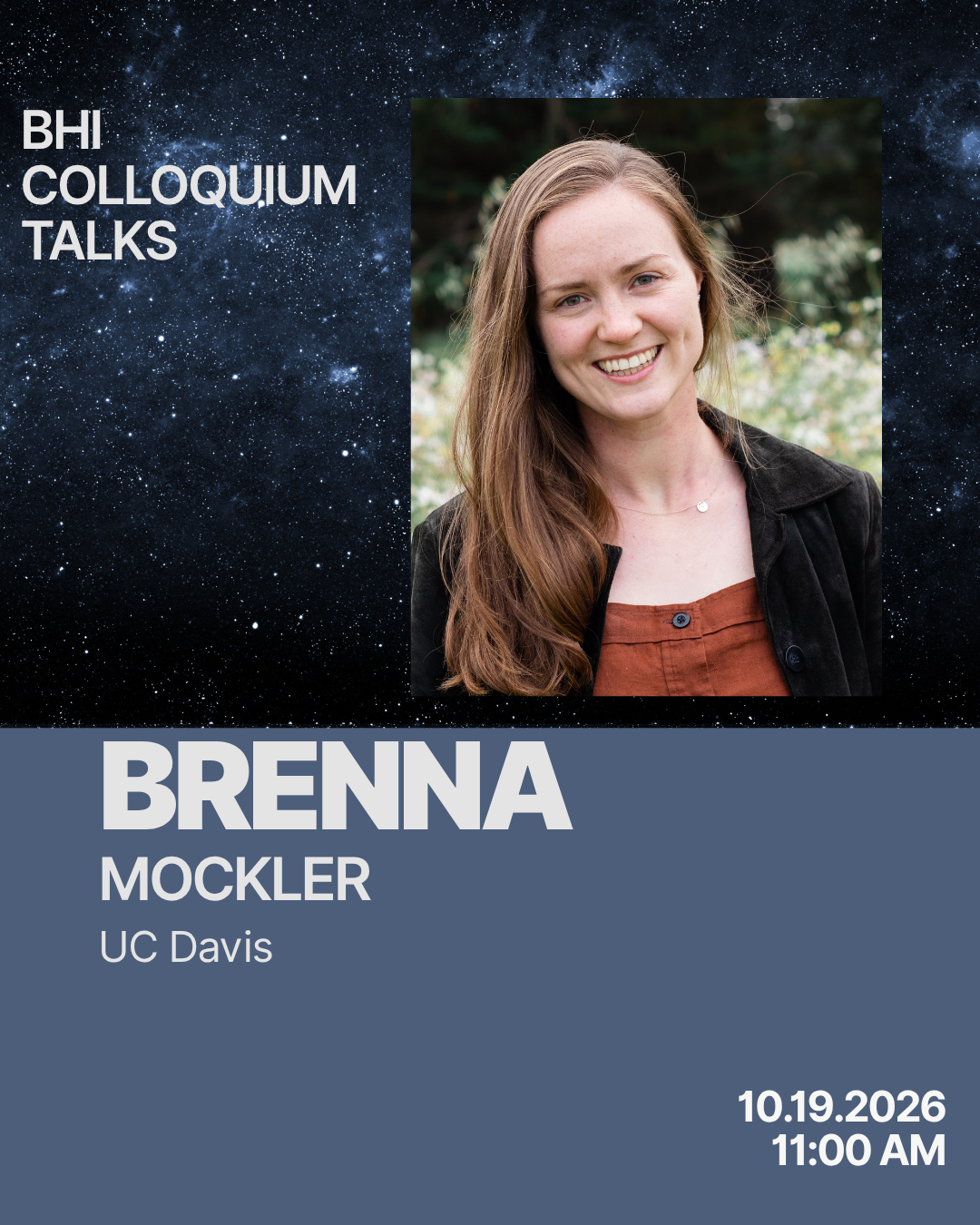
Brenna Mockler
Description
Modeling emission from super-Eddington supermassive black holes
Tidal disruption events (TDEs) light up hidden supermassive black holes and encode information about the
properties of both these black holes and their environments. They also regularly produce super-Eddington
mass return rates, providing a local test of extreme black hole growth. The light curves and spectra of TDEs
show signatures of these super-Eddington feeding rates, including evidence of large outflows, very high
electron densities, and strongly ionizing but obscured emission. Many of these signatures are also seen in
other candidates for super-eddington accretion, including luminous fast blue optical transients, ambiguous
nuclear transients, and little red dots. However, properties of the system such as the origin, mass/energy
budget and black hole mass are often better understood in TDEs. I’ll discuss how we can use theoretical
models to connect the observed light curves and spectra to the actual source emission as well as to the
properties of the gas surrounding the black hole in these transients. More broadly I’ll discuss how we can
combine theoretical models with observations to investigate the black hole mass function, probe emission
from forming and evolving accretion disks, and study the properties of stars on size scales we cannot
observe outside our own galactic nuclei.
When
Monday, October 19, 2026 11:00 AM
Where
Inperson
G10
Virtual
Zoom
Share
BHI News