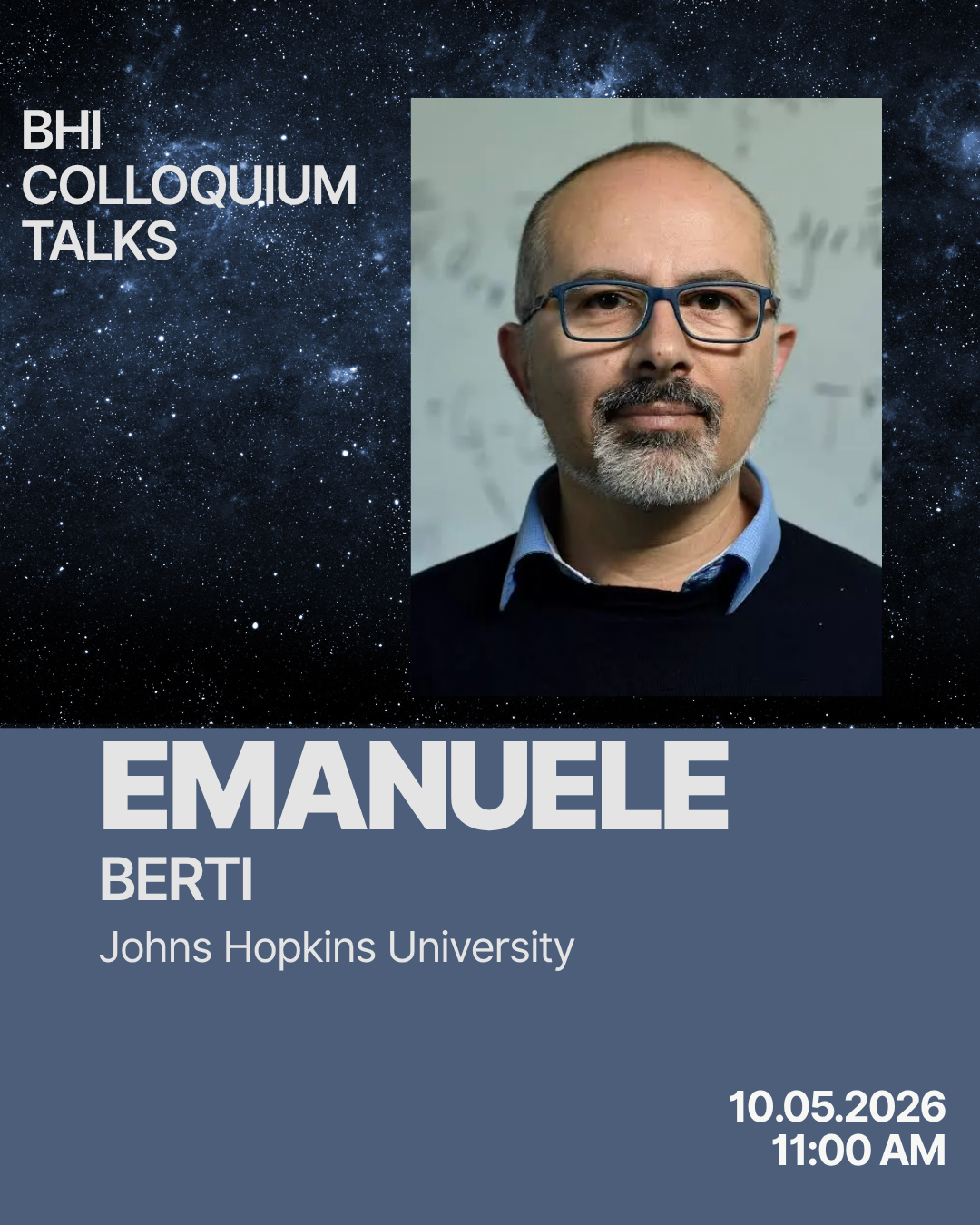
Emanuele Berti
Description

Image: Ana Carvalho
Is LIGO really observing black holes?
The observation of gravitational radiation emitted by black hole mergers is now providing direct experimental evidence of black holes. According to general relativity, the merger remnant emits “ringdown” radiation: a superposition of damped exponentials (“quasinormal modes”) with complex frequencies that depend only on the final black hole’s mass and spin. These spectral lines uniquely identify the black hole, just like the 21 cm line identifies interstellar hydrogen. In the first part of the talk I will discuss recent theoretical and experimental developments in this “black hole spectroscopy” program, including the importance of nonlinear effects and new models of the frequency-domain waveform based on the black hole’s greybody factors. In the second part of the talk I will discuss recent subsolar-mass LIGO-Virgo-KAGRA public alerts. If these events are real, it is tantalizing to conclude that they may be primordial black holes. I will argue that one should first exclude alternative explanations of astrophysical origin, such as the merger of subsolar-mass neutron stars formed in collapsar disks.
When
Monday, October 5, 2026 11:00 AM
Where
Inperson
G10
Virtual
Zoom
Share
BHI News