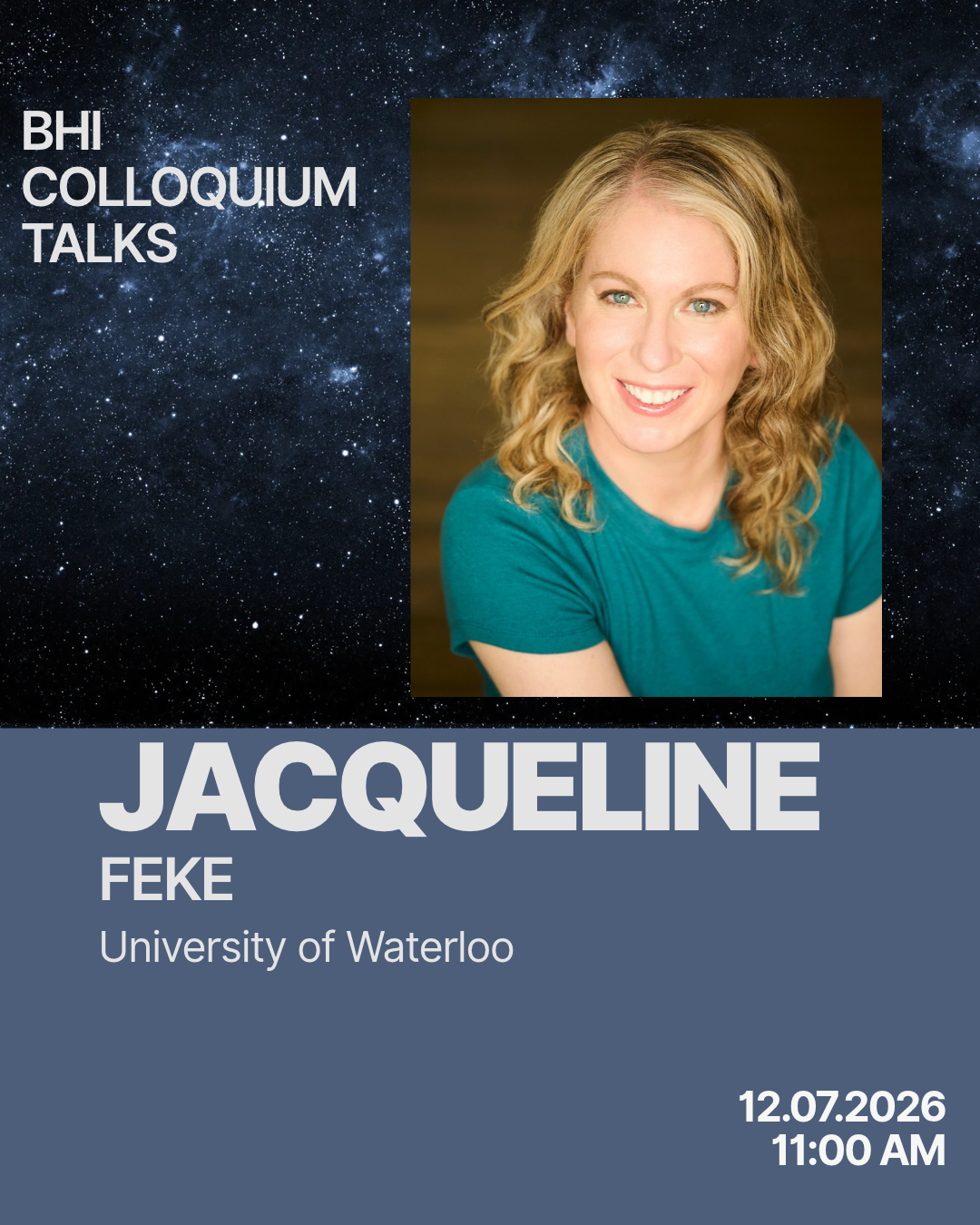
Jacqueline Feke
Description
Simplicity and Equipoise: The Origins of Criteria for Astronomical Models in Ancient Greece
Why do astronomers value theories and models that are as simple as possible? Historically, this criterion emerged as a solution to a dilemma ancient Greek mathematicians faced. The aim of ancient Greek astronomy was to construct models that corresponded to the true configurations of bodies in the heavens— that is, the realm from the Moon outward to the spherical circumference of the cosmos—but two models equally accounted for the Sun’s apparent motion: the eccentric model and the epicyclic model. In this talk, I will examine two criteria that mathematicians used to choose between these models: simplicity and equipoise. In the Almagest, Ptolemy appeals to simplicity as grounds for preferring the eccentric model for the Sun’s motion, whereas Theon of Smyrna, a second-century Platonist, ascribed to Hipparchus the use of equipoise as a criterion for preferring the epicyclic model. I will analyze what Ptolemy and Theon meant by ‘simplicity’ and ‘equipoise’, how they used these criteria to adjudicate between competing astronomical models, and why, philosophically, they were concerned with simplicity and equipoise, respectively.
When
Monday, December 7, 2026 11:00 AM
Where
Inperson
G10
Virtual
Zoom
Share
BHI News