
BHI Colloquium
INPERSON
BHI Conference Room and Zoom
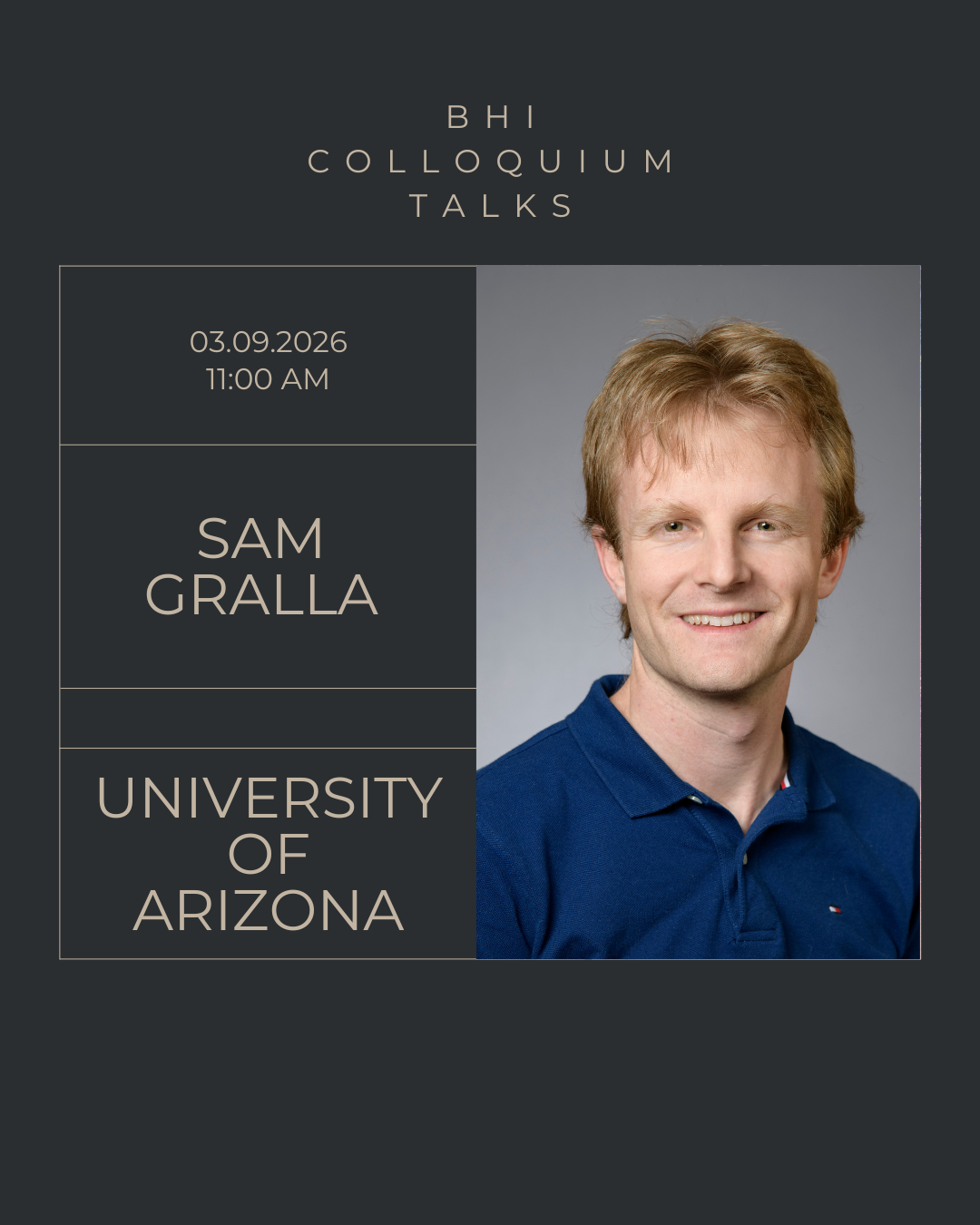
Sam Gralla
Description
Can Black Holes Evaporate Past Extremality?
Black holes with sufficiently large initial charge and mass will Hawking-evaporate towards the extremal limit. The emission slows as the temperature approaches zero, but still reaches the point where a single Hawking quantum would make the object superextremal, removing the horizon. We take this semiclassical prediction at face value and ask: When the emission occurs, what is revealed? Using a simple thin-shell model for the matter originally forming the black hole, we find that this matter *re-emerges* after the horizon is removed and subsequently expands back to large radius. This expanding remnant has been bathed in the ingoing Hawking quanta during evaporation and presumably carries correlations with the outgoing quanta, offering the attractive possibility of studying information paradox issues in a setup where spacetime curvatures are globally small, so that quantum gravity is not required. Even for ordinary black holes that evaporate down to the Planck size, we propose a radical new scenario for the interior: rather than forming a singularity, the collapsing matter settles onto an \textit{outgoing} null trajectory \textit{inside} the horizon for the entirety of evaporation.
When
Monday, March 9, 2026 11:00 AM
Where
Inperson
BHI Conference Room and Zoom
Share
BHI News